
Tiered link building is a way of building links in layers: links to your website, and then links to the pages that already link to you. Some SEO professionals do this because a backlink only helps if search engines can find it, trust it, and keep coming back to it. Adding a few relevant links to that page is one way to support it.
The basic setup is simple. Tier 1 backlinks point to your site. Tier 2 backlinks point to your Tier 1 pages. Tier 3 backlinks point to your Tier 2 pages. It’s easy to understand, and just as easy to abuse, which is why it needs care.
At Serpprize, we help SaaS brands build links, and tiered link building is something we get asked about a lot. Is it worth doing? Is it safe? Does anyone really need Tier 3?
In this guide, we’ll cover what tiered link building is, how each tier works, the benefits and risks, a step-by-step strategy, the best sites and tools, and whether it still works in 2026.
What Is Tiered Link Building in SEO?
Tiered link building means organizing your backlinks in layers, or tiers. The first layer links straight to your website. The layers after that link to the pages that carry those first links. Some people call it tier link building, or write it as tiered linkbuilding. It all means the same thing.
A normal link building plan asks, “How do I get more links to my site?” A tiered plan adds a second question: “How do I support the pages that link to me?”
How the link-building pyramid works. Picture a pyramid with your website at the top. Each layer underneath supports the layer above it. A respected industry blog links to your product page. That’s a Tier 1 backlink. Then a newsletter, a resource page, and another article link to that blog post. Those are Tier 2 links. They don’t point to you. They point to the page that points to you.
Why SEO professionals build links to existing backlinks. A link on a page nobody can find isn’t much use. A page with few links of its own may be crawled less often, and may get little traffic. By giving a good Tier 1 page a few relevant links of its own, you help it get discovered and noticed.
It’s worth being clear about one thing. Building links to a backlink doesn’t guarantee that Google will pass extra ranking value to your page. It’s a way to support a good link, not a trick.
How it differs from traditional link building. In traditional link building, almost all your effort goes to your own pages. In tiered link building, part of the effort goes to other people’s pages, the ones that already link to you. That extra step makes it harder to manage, and easier to misuse.
How Does Tiered Link Building Work?
Tiered backlinks work as a chain. Each layer sits one step further from your website, and each one supports the layer above it. The further down you go, the easier it is to cut corners.
How Do Tier 1 Backlinks Work?
Tier 1 backlinks are links that point straight to your website. A guest article on a relevant publication, a mention in an industry roundup, or a link on a partner’s resource page are all good examples.
These links count the most, so they should meet the highest standard: a relevant site, real editorial judgment, and a link that makes sense for the reader. Everything below them depends on how good they are.
What Are Tier 2 Backlinks?
Tier 2 backlinks point to the pages that link to you, not to your own site. If a blog post links to you, any link pointing to that blog post is a Tier 2 backlink.
This is what people mean by tier 2 link building, or second tier link building. So, what is tier 2 link building in plain terms? It’s the slow, selective work of getting relevant links to your Tier 1 pages. Done well, it supports good content. Done badly, it’s a pile of low-quality links.
What Are Tier 3 Backlinks?
Tier 3 backlinks point to your Tier 2 pages, which puts them two steps away from your site. Most honest campaigns never need them.
In practice, this is the layer where a lot of low-value, automated link creation happens, because it feels far enough from the main site that nobody will notice. Google can still spot patterns, so treat this layer with real caution.
How Do Different Backlink Tiers Connect?
Here’s the tiered link building pyramid in a simple form. Tier 2 links point to Tier 1 pages, and Tier 3 links point to Tier 2 pages.
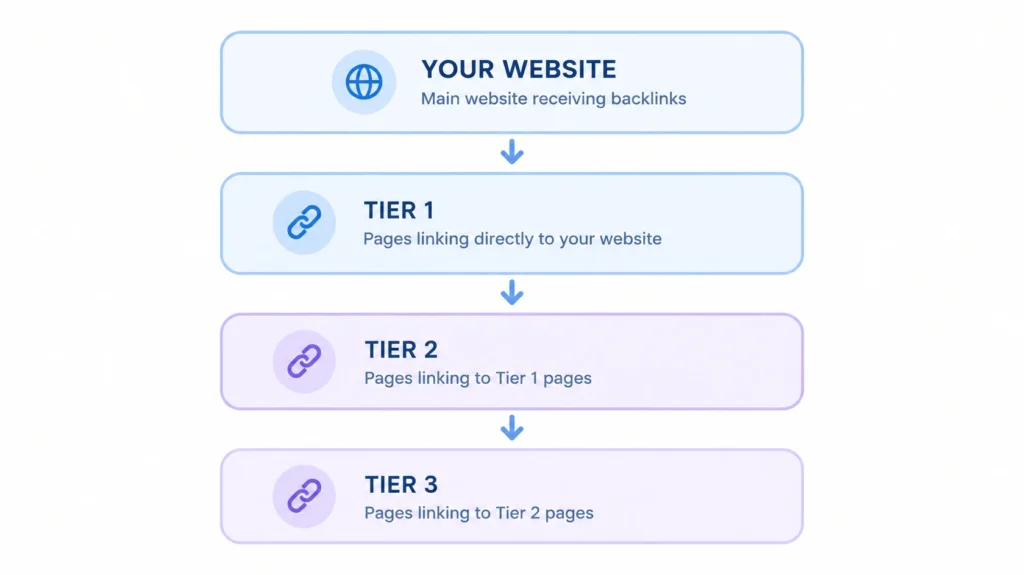
If every link in the chain is relevant and made for real readers, the setup is easy to defend. If the lower layers are full of spammy pages, the whole chain looks weak. The quality of each tier matters far more than how many tiers you have.
What Is the Difference Between Tier 1, Tier 2 and Tier 3 Backlinks?
Each link building tier has its own job and its own level of risk. Here is how the three compare.
| Factor | Tier 1 | Tier 2 | Tier 3 |
| Link destination | Your target website | Your Tier 1 links | Your Tier 2 links |
| Purpose | Direct authority and relevance | Support existing backlinks | Support lower-tier links |
| Quality | High | Relevant and credible | Quality still matters |
| Risk | Depends on link practices | Depends on link practices | Higher risk with automation |
| Typical example | A guest article on an industry site | A newsletter mention of that article | A reference to that newsletter post |
As the tier number goes up, the value usually goes down, and the pull toward spammy shortcuts goes up. Tier 2 backlinks can be fine when they’re relevant. Tier 3 deserves the most caution.
What Are the Benefits of Tiered Link Building?
Used carefully, with relevant and editorial links, a tiered link building strategy can help in a few practical ways:
- It supports your existing backlinks. If a good article links to your site, giving that article more visibility can help it get found and revisited.
- It organizes how you get links. Instead of collecting links at random, you decide which pages matter and plan support around them.
- It builds a structured campaign. Splitting the work into tiers makes it easier to track what you’re doing, and why.
- It supports discovery and referral pathways. Links pointing to a Tier 1 page can help people, and search engines, find their way to your site through it.
None of this is guaranteed. We wouldn’t promise ranking gains from any of these benefits, and nobody else should either. Stronger Tier 1 links will almost always do more for you than a complicated structure underneath them.
What Are the Risks of Tiered Link Building?
The structure itself isn’t the problem. The tiered link building risks come from how people build it, especially the lower tiers.
Can Low-Quality Tier 2 Backlinks Harm Your SEO?
They can. Low-quality Tier 2 backlinks usually come from spun articles, auto-generated pages, link farms, and blog comments. They’re cheap and fast, which is exactly why they’re risky.
Three problems come up again and again:
- The pages hosting your Tier 1 links can look spammy by association.
- Your Tier 1 publisher may not be happy to find junk links pointing at their article.
- You lose the one thing that makes the approach defensible, which is relevance.
Even if Google doesn’t penalize your site, it may simply ignore links it sees as unnatural. Then you’ve spent time and money on links that do nothing.
What Happens When You Build Too Many Aggressive Tier 1 Backlinks?
Aggressive Tier 1 backlinks are a risk on their own, before any lower tier is involved. Think of a burst of exact-match anchor links to one page, or lots of links from unrelated sites in a short time. Sudden spikes and repeated anchor text look unnatural.
When the pattern looks forced, search engines may discount the links. In the worst case, it can attract a manual action. A steady, natural pace is much safer.
Can Tiered Link Building Violate Google’s Spam Policies?
It can, depending on how you do it. Tiered link building isn’t automatically against the rules. But Google’s spam policies define link spam as links created mainly to manipulate search rankings, and several of the examples it lists are common in low-quality tiered setups.
According to Google’s spam policies, examples of link spam include:
- Buying or selling links that pass ranking credit
- Excessive link exchanges, or pages made only for cross-linking
- Using automated programs or services to create links to your site
- Large-scale guest posting or article campaigns with keyword-rich anchor text
In other words, manipulative link schemes, automated link creation, and irrelevant backlinks are where the trouble is. Google also uses automated systems to find and neutralize unnatural links, and it can issue manual actions for violations. So the line comes down to intent and quality. A relevant link added because it helps readers is fine. A batch of links created mainly to push a page up the rankings is not.
You can read the details yourself in Google’s spam policies for web search.
How to Build a Tiered Link Building Strategy Step by Step
Here is a practical tiered link building tutorial you can follow from start to finish. It avoids automation and shortcuts on purpose. If you’re looking for advanced tiered link building, the honest answer is that the advanced part is mostly discipline: knowing what to support, and what to leave alone.
Step 1: Identify Your Target Pages
Start with your own site. Pick the pages that truly deserve links: a product page, a pillar guide, a research piece, or a comparison article. If a page wouldn’t earn a link on its own merits, don’t start building links to it.
A good test is to ask, “Would someone link to this without being asked?” If the answer is no, improve the page first. Strong content makes every tier easier and safer.
Step 2: Build Relevant Tier 1 Backlinks
Everything depends on this step. Without strong Tier 1 links, there’s nothing worth supporting.
Aim for links from relevant sites that make sense in context: a helpful guest article, a data mention, a partner page, or a quote in an industry piece. Keep your anchor text natural, and don’t rush. If you want ideas for earning stronger placements, our guide on how to get high PR backlinks is a good place to start.
Step 3: Analyze Your Existing Tier 1 Backlinks
Before you build anything underneath them, check what you already have. Ask a few simple questions about each Tier 1 link:
- Is the site relevant to your industry?
- Is the linking page indexed and getting some visibility?
- Does the link sit naturally inside useful content?
- Is the page worth supporting at all?
You’ll probably find that only a handful of your Tier 1 links deserve extra effort. That’s normal. Support the best ones, and leave the rest alone. Supporting a weak page only makes a weak page more visible.
Step 4: Build Relevant Tier 2 Backlinks
This is where tier 2 link building actually happens, and it should be slow and selective. Instead of mass-producing links, think about how that Tier 1 page could earn attention naturally.
A few safe ideas:
- Mention or reference the page in a related article you publish
- Include it in a newsletter or resource roundup
- Share it in a relevant community where it genuinely helps
- Link to it from another good page on a site you control or have a real relationship with
If a Tier 2 link wouldn’t make sense to a normal reader, skip it. Keep the number small and the pace steady.
Step 5: Understand When Tier 3 Backlinks Are Appropriate
In most cases, they aren’t needed. Tier 3 only makes sense when a Tier 2 page is genuinely valuable in its own right, for example a respected industry article that people naturally reference.
Even then, those references should happen naturally. Never use automated tools, spun content, or throwaway sites to create this layer. If you can’t explain why a Tier 3 link exists in one sentence, you don’t need it.
Step 6: Monitor and Evaluate Your Backlink Profile
Once links go live, keep an eye on them. Check which ones are still live, which pages get traffic, and whether any new links look off. Google Search Console’s Links report is a good free place to start, and a backlink checker adds more detail on referring domains and anchor text. Review everything about once a month, so small problems don’t grow.
Then do an honest quality review:
- Stop any practice that involves automation, paid placements that pass ranking credit, or networks of low-quality sites.
- Watch for repeated, keyword-heavy anchor text.
- If you’ve inherited bad links, try asking the site owner to remove them. Google’s disavow tool exists, but Google says most sites don’t need it, so only think about it if you have a large number of spammy links.
A small, clean structure beats a big, messy one every time.
A Practical Example: A Hypothetical SaaS Website
Here’s a made-up example to show how the steps fit together. It isn’t a real tiered link building case study, and we’re not claiming any results from it.
Imagine a small invoicing software company with one strong comparison page. This is its target page.
- Tier 1: A guest article on an accounting blog that links to the comparison page, and a mention in an industry roundup.
- Tier 2: The company references that guest article in its own blog post and newsletter, and an industry community shares it where it’s relevant.
- Tier 3: None. The company decides it isn’t needed.
- Monitoring: Each month, the team checks that the links are live, the pages are indexed, and nothing odd has appeared.
It’s modest, and that’s the point. If you run a SaaS site and want the bigger picture of how link building fits into growth, our Enterprise SaaS SEO guide explains how to prioritize pages and channels.
What Are the Best Sites for Tiered Link Building?
There isn’t a magic list of websites, and anyone selling one should make you suspicious. The best sites for tiered link building are the ones that would make sense for your audience even if search engines didn’t exist. Here are the main types to look at:
- Relevant industry blogs. They have real readers and a clear focus.
- Editorial publications. Sites where editors decide what gets published.
- Resource pages. Pages that curate helpful links on one subject.
- Niche-relevant websites. Smaller audiences, but often highly engaged.
- Business directories. Choose carefully, and only use ones people actually use.
- Relevant community platforms. Forums and groups where you can add real value.
How to Judge a Site Before You Build a Link
Relevance comes first. Does the site cover your industry or something close to it? Our article on relevant backlinks explains why relevance and quality matter more than raw numbers.
Next, look at editorial standards. Does the site publish original, useful content, or does it accept anything for a fee? Check for real authors, recent posts, and a normal mix of outbound links. Then look at traffic and backlink quality. A site with real visitors and a clean link profile is a better sign than a big number on a metric.
Don’t pick a site just because it has a high DR. A high score doesn’t make a site relevant, and it doesn’t make the link safe. If it looks like it exists only to sell links, walk away.
What Tools Can Help With Tiered Link Building?
You don’t need much to manage a clean tiered setup. The best tiered link building tools help you do three things: see your backlinks, judge their quality, and keep an eye on changes. None of them can decide whether a link is a good idea, and none will build a safe structure for you.
Ahrefs for Backlink Analysis
Ahrefs is useful when you want to see who links to you, which pages they link to, and which anchor text they use. It also helps you look at the linking pages themselves, so you can decide whether a Tier 1 page is worth supporting. What it can’t do is tell you whether a link is editorially earned.
Semrush for Competitor and Backlink Research
Semrush helps you study the backlink profiles of your competitors. That’s handy for spotting the kinds of sites and pages that link to similar products, and for finding gaps in your own profile. Like any tool, it shows you data, not a verdict.
Google Search Console for Link Monitoring
Search Console is free, and it shows which sites link to yours and which pages get linked most. It won’t give you the depth of a paid tool, but it comes straight from Google, so check it regularly.
Other Useful Backlink Analysis Tools
Smaller backlink checkers can fill in the gaps, especially for quick checks on link status or anchor text. If budget is tight, our roundup of the cheapest SEO tools can help you put together a sensible toolkit.
Whichever tools you pick, remember that the judgment is still yours.
Tiered Link Building vs. Traditional Link Building: What’s the Difference?
Both approaches can work, but they ask for different amounts of time and care. A tiered backlink strategy adds layers of work, and layers of risk.
| Traditional link building | Tiered link building | |
| Structure | One layer of links pointing to your site | Several layers, with links pointing to other backlinks |
| Link destinations | Your own pages | Your pages, plus pages that link to you |
| Complexity | Lower | Higher |
| Maintenance | Check your own links | Track links across several layers |
| Risks | Lower when links are editorial | Higher, because lower tiers are easy to abuse |
| Use cases | Most websites, most of the time | Mature sites with strong Tier 1 links and the capacity to manage them |
For most SaaS companies, the better move is to spend your time on stronger Tier 1 links before you think about tiers at all.
Does Tiered Link Building Still Work for SEO in 2026?
Honestly, it depends on what you mean by “work.”
How search engines evaluate backlinks. Search engines treat links as one signal among many. They try to work out whether a link is natural, relevant, and useful to a real reader. Google has also built systems to spot and neutralize unnatural links, which makes cheap, automated tactics a poor bet.
Whether links to existing backlinks add measurable value. There’s no solid public proof that they do. Any benefit is likely to be indirect. A good Tier 1 page that gets a bit more visibility might be easier to discover. That’s a modest gain, not a ranking trick, and it doesn’t guarantee Google will pass extra value to your page.
Relevance and editorial quality. These matter far more than the number of tiers. A small, relevant, well-edited set of links is easier to defend than a large one you can’t fully explain.
Why automated link pyramids are risky. Mass-created links, spun content, and networks of throwaway sites are what Google’s spam policies are aimed at. Automated link pyramids are the oldest form of tiered link building, and also the most likely to backfire.
So yes, a careful version can still make sense in some cases. The old, automated version isn’t worth the risk.
What Are the Best Practices for Tiered Link Building?
If you decide to use a tiered link building strategy, keep these habits:
- Prioritize relevant backlinks. Every link, at every tier, should make sense for the reader.
- Focus on editorial quality. A link an editor chose is worth far more than one you placed yourself.
- Avoid automated mass link creation. Tools that produce links in bulk are the fastest route to trouble.
- Monitor referring domains. Check regularly for odd spikes, spammy domains, or sites you don’t recognize.
- Maintain natural anchor text. Mix up brand names, plain URLs, and natural phrases. Repeating the same keyword is a pattern that stands out.
- Keep your tiered backlinks proportionate. Don’t build far more lower-tier links than the Tier 1 page deserves.
- Follow Google’s spam policies. Read them. If a tactic only makes sense because it manipulates rankings, drop it.
The best advanced tiered link building isn’t about adding more tiers. It’s about doing the basics well, and having the patience to leave out anything that doesn’t earn its place.
Conclusion
Tiered link building can be a useful way to organize your link work and support the pages that already point to you. But it only works as well as the links underneath it. Strong Tier 1 backlinks matter most, careful Tier 2 backlinks can support them, and Tier 3 usually isn’t worth the risk. Its benefits are modest, its limits are real, and the risks grow quickly when automation gets involved.
The main lesson is simple: quality beats quantity. A few relevant, editorial links will do more for you than hundreds of cheap ones, and they won’t put your site in danger.
If you’d like help building a link profile that’s relevant, clean, and built to last, Serpprize can help with SaaS link building. And if you’re comparing any tiered link building service, ask how links are earned, which sites they come from, and whether any part of the process is automated. If the answers are vague, that tells you what you need to know.
Frequently Asked Questions About Tiered Link Building
1. What Is Tiered Link Building in SEO?
Tiered link building is a method of building links in layers. Tier 1 links point to your website. Tier 2 links point to the pages that hold your Tier 1 links, and Tier 3 links point to those Tier 2 pages.
2. What Are Tier 2 Backlinks?
Tier 2 backlinks are links that point to your Tier 1 pages, not to your own site. They’re meant to help those pages get found and noticed.
3. What Is the Difference Between Tier 1 and Tier 2 Backlinks?
Tier 1 backlinks point directly to your website. Tier 2 backlinks point to the pages that link to you. Tier 1 links matter most, while Tier 2 links play a supporting role.
4. Does Tiered Link Building Still Work?
A careful, relevant version might help in small ways, mostly by supporting good pages that already link to you. There’s no solid public proof of big ranking gains, and automated versions carry real risk.
5. Is Tiered Link Building Safe for SEO?
It can be, if every link is relevant and created for real readers. It becomes unsafe when it relies on automation, paid links that pass ranking credit, or networks of low-quality sites, since those can fall under Google’s link spam policies.
6. How Long Does It Take for Tier 2 Backlinks to Have an Effect?
There’s no fixed timeline, and no guarantee they’ll have any effect at all. Search engines have to find and recrawl the linking pages first, which can take days or weeks, and any benefit tends to show up slowly, if it shows up. Judge results over a few months, and judge the quality of each link, not just how fast it appears.
7. How Many Tier 2 Backlinks Should You Build?
There’s no magic number. Support only the Tier 1 pages that deserve it, and add links slowly and naturally. A handful of relevant links is better than a large batch.
8. What Are the Best Tools for Tiered Link Building?
Ahrefs and Semrush are helpful for analyzing backlinks and competitors, and Google Search Console is a free way to monitor links. The tools only give you data, so you still have to judge each link’s quality.